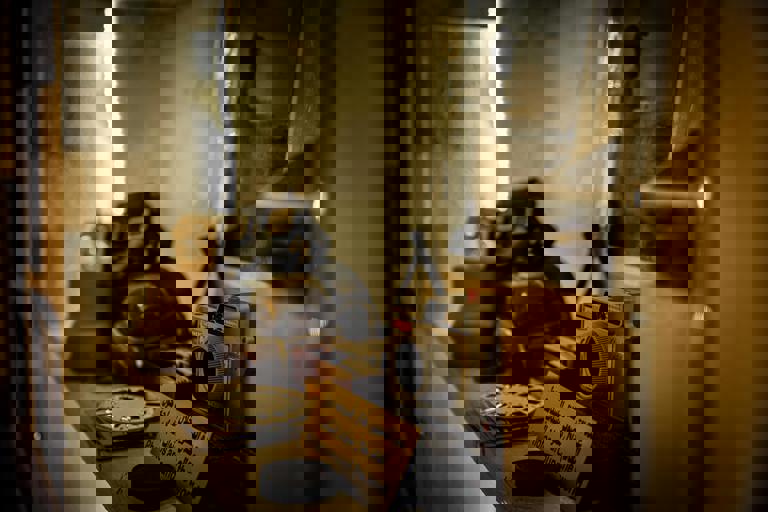
A remarkable discovery is sending ripples through Montreal’s art and culture communities this week. A trove of vintage poster art, untouched for decades, was found in the basement of a Plateau Mont-Royal townhouse during recent renovations. The collection, spanning from the late 1930s to the 1970s, has stunned experts and collectors alike with its breadth, condition, and historical significance, instantly becoming the talk of the city’s vibrant art scene.
The unassuming homeowner, Luc Pépin, had lived in the townhouse for more than twenty years before stumbling upon the cache behind a false wall. “I couldn’t believe my eyes—rare, beautifully preserved posters just stacked together,” Pépin recounted to local media. News of the discovery spread rapidly, prompting art historians to flock to the scene with hopes of cataloguing and authenticating each piece.
Experts promptly began examining the posters and were amazed to find works by renowned artists such as Henri de Toulouse-Lautrec, Paul Rand, and Mario Zampini, alongside vibrant advertisements for now-defunct Montreal theatres, jazz clubs, and even Expo 67 events. The posters’ well-preserved state has been attributed to optimal basement humidity and the lack of sunlight, offering a rare window into the city’s mid-20th-century cultural life.
Art historian Danielle Fournier said the collection “represents a fascinating snapshot of both international design trends and uniquely Quebecois creativity.” She described the posters as “not merely decorative pieces, but social artifacts that reveal how Montreal engaged with and contributed to broader artistic movements.” Fournier and her team are meticulously documenting the collection’s provenance, intending to publish their findings later this year.
Collectors are already expressing huge interest in acquiring pieces, with some posters expected to fetch thousands of dollars each at auction. Montreal-based art dealer Marc Tessier noted, “Original prints from this era, especially in such immaculate condition, are exceedingly rare. The market for vintage poster art has skyrocketed in recent years, and this find is likely to draw global attention.” His gallery is already fielding inquiries from as far away as Paris and New York.
Beyond their artistic value, the posters offer important sociocultural context. Many depict iconic Montreal events, including the famed International Jazz Festival, theatre debuts, and pivotal moments in the city’s history. Dr. Louise Talbot, a sociologist at McGill University, explains, “Artworks like these are historical documents. They capture the optimism, anxieties, and evolving identities of Canadians during transformative decades.” Researchers believe this discovery could reshape understandings of Montreal’s cultural evolution.
Interestingly, some posters have sparked debate regarding forgotten or underappreciated artists. For example, several pieces are signed by Anna Tremblay, a once-prolific Montreal illustrator whose works had faded from public memory. This unearthing has prompted fresh scholarly inquiry into her career and the broader contributions of women to the city’s visual culture. Plans are in motion to mount a retrospective exhibition of her work in collaboration with local museums.
The discovery has also created a buzz within the design community. Jean-Marc Pelletier, president of the Quebec Graphic Artists Association, emphasized how these posters reflect the technical and aesthetic trends of their time—ranging from early art deco influences to bold, psychedelic forms of the 1960s. “For local designers, this is an invaluable archive that demonstrates both innovation and adaptation within the Canadian context,” he noted.
Montreal’s municipal government is getting involved too. The city’s culture and heritage department has approached Pépin about acquiring or loaning part of the collection for public exhibition. Councillor Mireille Lévesque stated, “These posters belong not just to collectors, but to all Montrealers. We hope to showcase them in a way that educates and inspires new generations about our rich artistic heritage.” Talks toward a future exhibition at the Musée des beaux-arts de Montréal are ongoing.
Enthusiasm for the collection extends far beyond art circles. Local schools are considering educational programs that use the posters to teach students about history, graphic design, and civic identity. Evelyn Chau, an elementary school teacher, reflected, “This is a unique opportunity for young people to connect with the past and see how visual culture shapes everyday life.” The pedagogical potential of the collection continues to spark innovative ideas across the education sector.
As experts assess and digitize the collection for wider access, speculation abounds about what might still lie hidden in Montreal’s historic neighborhoods. The story of the poster discovery serves as a reminder that the artifacts of cultural memory are often closer than we think—waiting in basements, attics, or behind false walls, ready to inspire new appreciation for the city’s storied past. The art world waits with bated breath to see how this extraordinary find will reshape understandings of Canadian art history.